AI Bookkeeping in Finland: How Automated Account Coding Really Works
AI bookkeeping can read receipts and bank transactions, suggest accounts and VAT treatment, and route uncertain cases to an accountant. Here is how to assess it in a Finnish bookkeeping workflow.
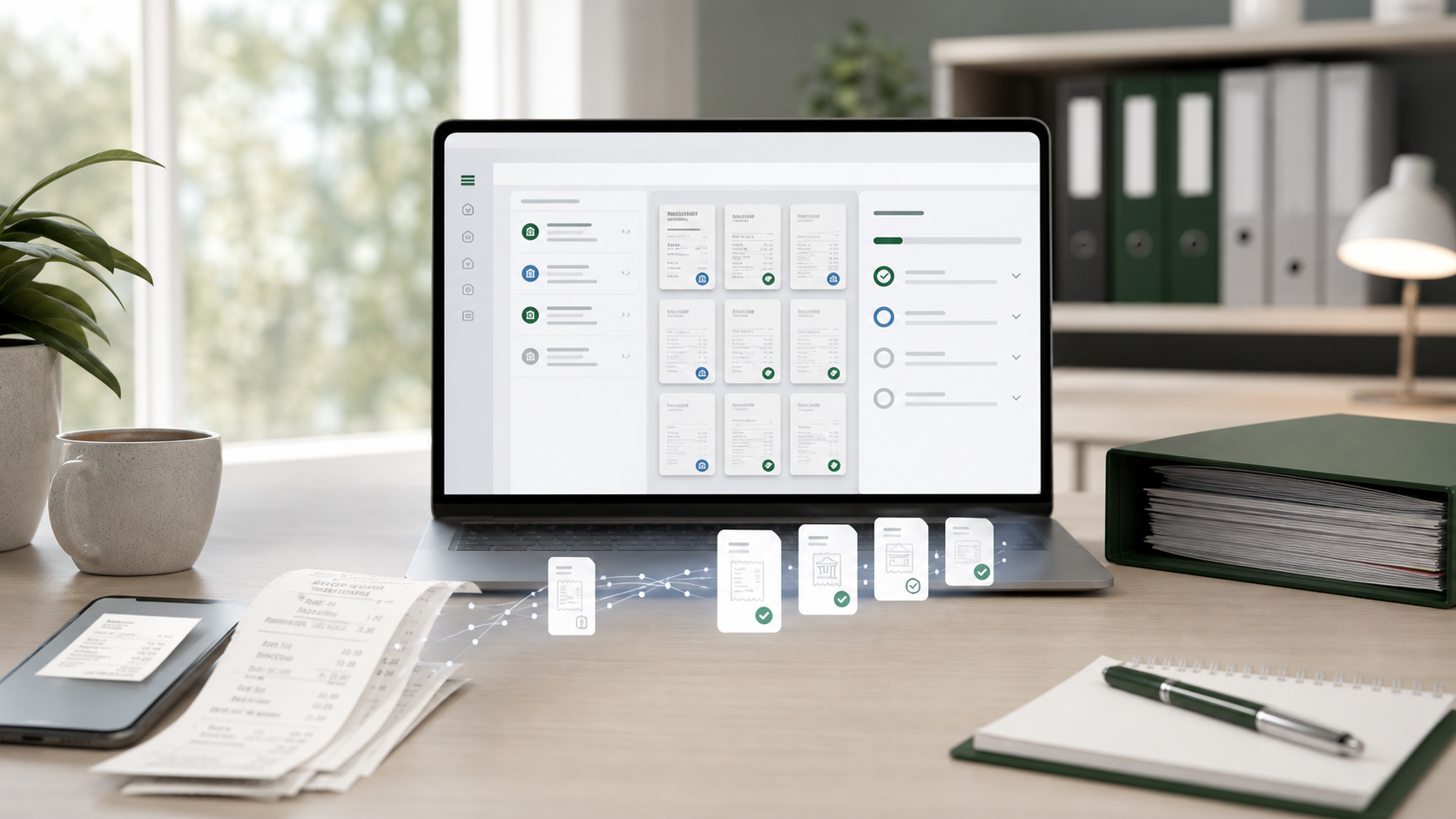
In Finnish accounting software, you may see the word tiliöinti. It means deciding how a transaction is posted: the ledger account, VAT treatment, counter-entry and any cost centre or project. AI-assisted account coding prepares those decisions by reading the document, the payment and the company’s earlier bookkeeping together.
That is more useful than simply extracting a date and total from a PDF. It is also not a licence to approve every suggestion. A sound workflow automates familiar transactions and makes uncertainty visible before anything reaches a VAT return or management report.
What AI account coding should produce
A useful suggestion can include:
- the general-ledger account
- the Finnish VAT code and deductible share
- a match between a receipt, invoice and bank transaction
- a cost centre, project or other reporting dimension
- an accrual or fixed-asset warning
- a short explanation and confidence level
For example, the system may recognise a recurring EUR 124.90 software invoice, compare it with earlier months, suggest an IT-services account and the relevant VAT treatment, and match it to the bank payment. The accountant then checks the result instead of building the entry from an empty form.
OCR, rules and AI are different tools
| Method | What it does well | Where it stops |
|---|---|---|
| OCR | Reads supplier, date, amount and VAT from an image or PDF | Does not necessarily understand how the purchase should be booked |
| Rule automation | Repeats a known instruction, such as “supplier X goes to account Y” | Can fail when the invoice content or VAT treatment changes |
| AI account coding | Uses the document, bank event, history and company context together | Still needs controls and professional review for judgement calls |
Rules remain excellent for rent, bank fees and other stable recurring items. AI adds value when the supplier is new, an invoice has several types of cost, VAT varies, or the same merchant sells both business and private-use items.
A reliable workflow in eight steps
- A receipt, e-invoice, PDF or bank transaction enters one agreed channel.
- The software reads the key fields and invoice lines.
- It matches the document with an invoice or payment.
- It checks how comparable transactions were treated for this company.
- It proposes the account, VAT code and reporting dimensions.
- Low-confidence or unusual cases are placed in a review queue.
- An accountant or authorised user accepts or corrects the entry.
- The correction improves future company-specific suggestions.
Step six matters most. Software that always sounds certain can scale mistakes. Good AI is allowed to say that it does not have enough information.
What must still be reviewed by a person?
Professional judgement is particularly important for:
- entertainment and marketing expenses
- employee benefits and payroll-related purchases
- mixed private and business use
- foreign purchases, EU trade and reverse-charge VAT
- fixed assets, depreciation and accruals
- shareholder transactions and related parties
- unusually large purchases or new suppliers
- incomplete receipts and unclear business purpose
The accountant remains responsible for the quality of the bookkeeping. AI changes the work from repetitive data entry to exception handling; it does not remove that responsibility.
How to measure quality
Do not buy “AI bookkeeping” on a demo slogan. Test it with real Finnish material and record:
| Measure | Useful question |
|---|---|
| First-suggestion accuracy | How often is the complete entry correct without editing? |
| Correction rate | Which accounts or VAT treatments are most often changed? |
| Coverage | How much of the monthly material receives a useful suggestion? |
| Human touch time | How long does review take per transaction? |
| Exception detection | Does the system flag missing evidence and unusual entries? |
| Company-specific learning | Does it stop repeating the same corrected mistake? |
The goal is not 100% automatic approval. The goal is fast handling of safe routines and early review of risky exceptions.
A practical 30-day pilot
Choose three to five representative clients, or one company with at least a normal month of activity. Include recurring invoices, card receipts, new suppliers, foreign purchases and missing-document cases. Measure the first suggestion, every correction, review time and the resulting audit trail.
At the end, ask where the system was uncertain, where it made a plausible but wrong suggestion, and whether a reviewer could understand why each entry was proposed. A confident-looking error is more dangerous than a case deliberately sent for review.
Tulos.ai brings document reading, bank matching, account and VAT suggestions, exception handling and month-end checks into one workflow. The aim is to remove repeated entry work while keeping the accountant in control of decisions that require expertise.
Also read Monthly Bookkeeping: Manual vs Automated Model, Collecting Receipts Without Chasing Clients and Choosing Accounting Software in Finland in 2026.
Sources
- Finlex: Accounting Act 1336/1997
- Finnish Tax Administration: Information on the VAT return
- Finnish Tax Administration: Deductions of VAT