The Accountant's Month-End Worklist: What to Automate and What to Review
A practical worklist for Finnish accounting firms: automate document collection, matching and reminders while keeping VAT exceptions, owner transactions and final close under professional review.

Not every accounting task should be automated. A useful division is simple: automate repeated collection, comparison and routing; keep interpretation, materiality and final approval with the accountant.
For a Finnish accounting firm, the best starting point is the monthly close. When the worklist is explicit, the team can see which steps follow stable rules, which require evidence from the client and which call for professional judgement.
A practical division of work
| Automate or prepare automatically | Keep under accountant review |
|---|---|
| Receipt intake and document routing | Whether evidence is sufficient for bookkeeping and VAT |
| Matching documents to bank transactions | Unusual VAT, EU and foreign-trade treatment |
| Detecting missing receipts | Shareholder, loan and related-party transactions |
| Recurring account-coding suggestions | Payroll, benefits and reimbursements with exceptions |
| Client reminders and follow-ups | Fixed assets, depreciation and accruals |
| Basic reconciliations and exception reports | Balance-sheet reasonableness and final month-end close |
Automation should prepare the case and preserve the evidence. It should not conceal the decision.
Build one month-end worklist
A scalable list usually has six stages:
- Material received: bank feeds, sales, purchases, payroll and expense reports have arrived.
- Evidence matched: each material bank or card transaction has a document or explanation.
- Entries prepared: repeat transactions have coding proposals and exceptions are separated.
- Reconciliations completed: bank, receivables, payables and payment services agree.
- Declarations reviewed: VAT and payroll information are checked against the ledger.
- Month approved: an accountant signs off the close and the client receives agreed reports.
Give every stage an owner and a clear definition of “done”. Otherwise a dashboard merely replaces an informal spreadsheet without improving control.
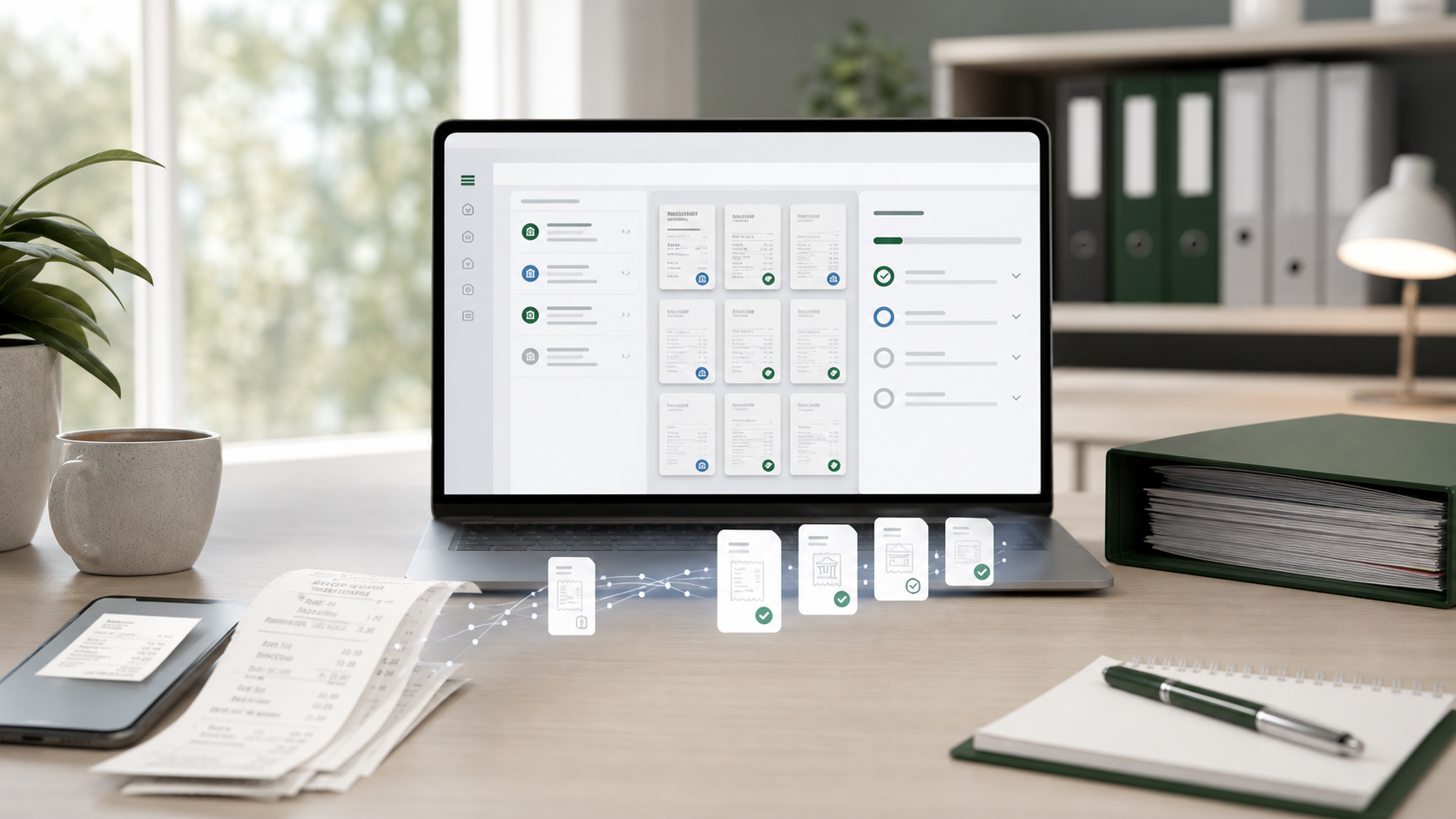
Automate material intake and missing-document detection
Clients should have a small number of agreed channels: mobile capture, a dedicated document email, e-invoices and controlled bulk upload. Files should enter the correct client workspace automatically rather than being downloaded and renamed by an accountant.
The system can then compare documents with bank and card activity and identify:
- payments without a receipt or invoice
- card purchases missing evidence
- payment-service settlements lacking a detailed report
- recurring suppliers whose normal invoice is absent
- owner-related or private-looking payments
- purchases that are unusually large for the client
The client should receive a specific request: date, amount, payee and what is needed. “Please send the missing receipts” creates another round of clarification.
Automate proposals, not blind approval
Recurring rent, software subscriptions, insurance, phone costs and bank fees are good candidates for rules or AI suggestions. Yet the system must still reveal when the content differs from earlier months, the VAT rate changes, an invoice contains several cost types or a purchase may be an asset.
The same principle applies to reconciliations. Software can compare totals and flag discrepancies. The accountant decides whether the cause is timing, a missing entry, a duplicate, a currency difference or an actual error.
Keep these checks with the accountant
VAT exceptions
Reverse charge, EU sales, imports, mixed-use purchases and limitations on deduction require context. A historical pattern is helpful but not decisive.
Owner and company transactions
In an Oy, the shareholder and company are separate. Salary, expense reimbursement, dividend, shareholder loan and private purchase cannot be treated as interchangeable cash movements.
Fixed assets and payroll
Large acquisitions may need depreciation or accrual. Employee benefits and reimbursements may affect payroll and Incomes Register reporting.
Final balance-sheet review
Bank accounts, receivables, payables, VAT balances, payroll liabilities, loans and equity should make sense together. Final sign-off must remain visible and attributable.
What not to automate first
Do not begin with clients whose records arrive through many uncontrolled channels, major historical corrections, unclear service scope or constantly changing reporting. Standardise the input and responsibilities first. Automation amplifies whatever process already exists, including disorder.
Measures for the accounting firm
Track missing documents per client, number of follow-ups, share of entries corrected after the first proposal, manual minutes per close, reopened periods and unbilled exception work. These measures show whether automation improves margin without weakening quality.
A 30-day rollout
- Days 1–5: write down the current worklist and owners.
- Days 6–10: separate routine steps from judgement calls.
- Days 11–15: standardise intake and automate specific reminders.
- Days 16–20: pilot coding suggestions and basic reconciliations.
- Days 21–30: measure corrections, close time and client exceptions; then update the service scope.
Tulos.ai supports this division by collecting material, detecting missing evidence, preparing account and VAT suggestions and placing exceptions in a shared queue. The accountant remains responsible for review and final close.
Summary
The right question is not “Can this task be automated?” It is “Which part is repetitive, which evidence is required, and where does professional judgement begin?” A strong month-end process automates collection and comparison, makes exceptions visible and records who approved the final result.